
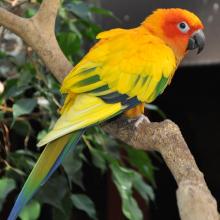
The Sun Conure is one of the most brightly coloured parrots in the world, known for its vivid yellow, orange, and red plumage, accented with green and blue on the wings and tail. Juveniles are mostly green and gradually develop their brilliant colours as they mature. This striking appearance makes them highly recognizable, but it has also contributed to their popularity in the pet trade.
Sun Conures inhabit open woodlands, savannahs, and forest edges, often near water sources. They are highly social birds, usually seen in pairs or small flocks, though larger groups may gather where food is abundant. Their extremely loud, high-pitched calls help maintain contact between flock members as they move through their habitat.
Their diet consists mainly of fruits, seeds, nuts, berries, and blossoms, along with occasional insects. They forage both in trees and on the ground, often travelling long distances between feeding areas. In some regions, they may feed on cultivated crops, bringing them into conflict with humans.
Sun Conures form strong monogamous pair bonds, with mates often staying together year-round. They nest in tree cavities, where the female lays 2 to 4 eggs. Both parents are involved in caring for the young, though the female does most of the incubation, which lasts about 23 to 27 days. Chicks remain in the nest for around 7 to 8 weeks and continue to depend on their parents after fledging.
Sun Conures can hybridize with closely related conure species, particularly within the genus Aratinga, when they are kept together in human care. These hybrids are sometimes bred intentionally for unusual colour combinations. However, hybridization is rare in the wild, as different species typically have distinct ranges, behaviours, and mate preferences that keep them reproductively separate.
The Sun Conure is currently listed as Endangered on the IUCN Red List. Its population has declined significantly due to habitat loss, trapping for the pet trade, and fragmentation of its range. Although breeding in human care is now common and has reduced pressure on wild populations, the species remains rare in its natural habitat. Conservation efforts focus on protecting remaining habitats and controlling illegal pet trade.