
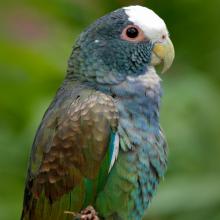
The White Capped Parrot is a social bird that travels in flocks of 10-50 individuals, looking for food together in the forest canopy. Their diet consists mainly of fruit, seeds, berries, and flowers, with occasional consumption of leaves or other plant material. They forage in the canopy and mid-level vegetation, often feeding quietly compared to many louder parrot species.
Breeding behaviour in the wild is not as extensively documented as in some other parrots, but they are believed to nest in tree cavities, where the female lays 2 to 4 eggs. Incubation lasts roughly three to four weeks, and both parents likely participate in feeding and protecting the young. Chicks remain in the nest until they are fully feathered and capable of flight, gradually gaining independence after fledging.
The White-capped Parrot is currently listed as Least Concern on the IUCN Red List due to its relatively wide range and stable population. However, like many bird species, it faces localized threats from deforestation, habitat fragmentation, and agricultural expansion.